A Real-life Applied Example of AI to an Ugly Workflow
One thing I’ve noted lately is that the real value of AI often isn’t doing the entire job. It’s reducing friction inside some very ugly workflows. I have a good example from this week which involved hazardous substances management.
WAIT!
Now before you reader switches off because hazardous substances registers are boring (so so boring), stay with me for a moment, because the actual lesson here has nothing at all to do with chemicals.
It’s about workflow bottlenecks.
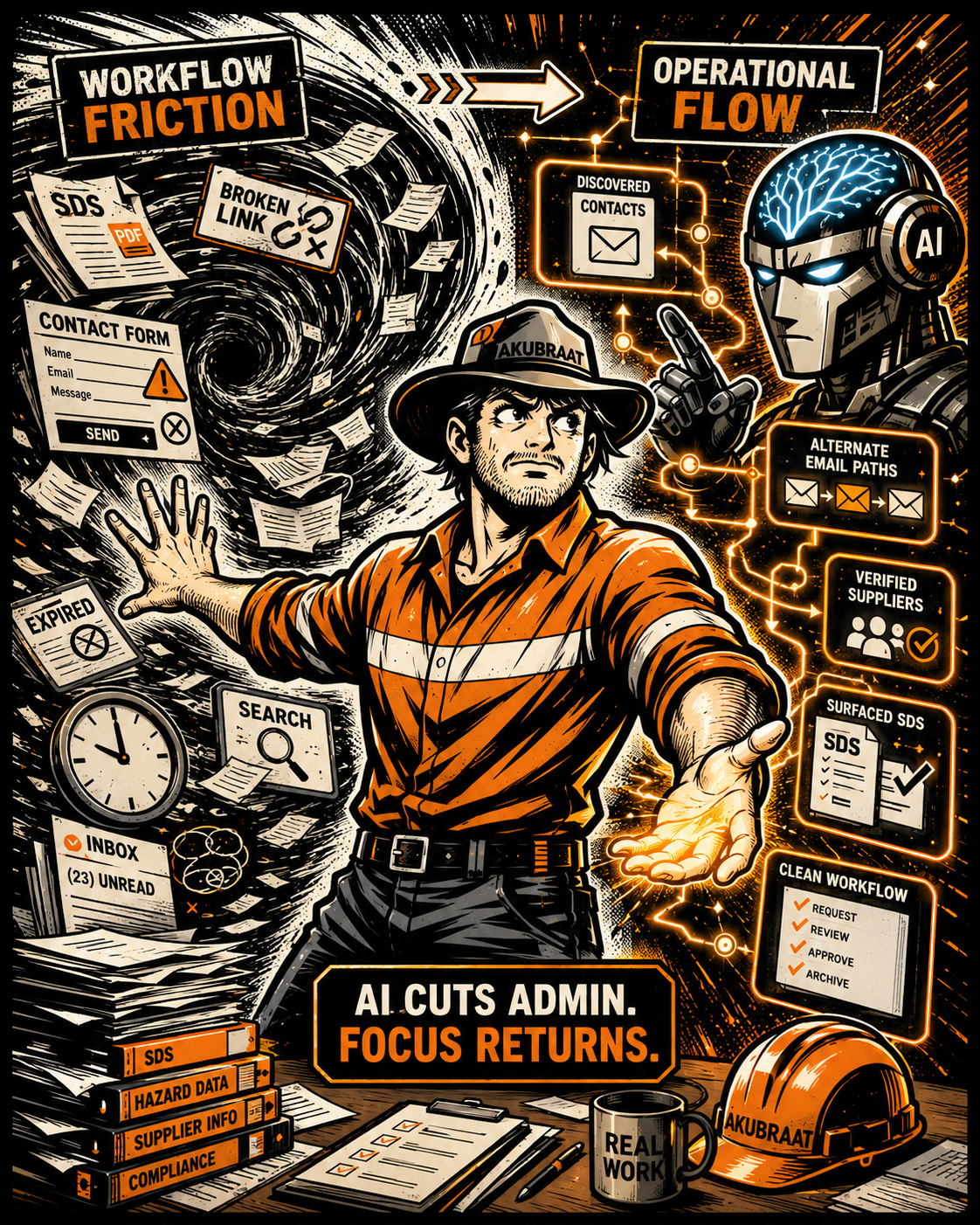
The Problem
I needed updated SDSs from a supplier for the register update. The old process normally goes something like this:
Search Google.
Find outdated PDFs.
Try the supplier website.
No, the SDS’s are all expired (true story on the Supplier site!) or links are broken or just missing.
Send enquiry through Supplier website contact form.
Record a comment in the Hazardous Substances register so you can at least demonstrate to an auditor that you are trying to resolve the missing or expired SDS.
Wait a few days.
Wait some more.
Receive no response.
Follow up again weeks later when you come back to the register.
Repeat process.
Sigh.
Anyone who’s maintained registers, procurement systems or compliance documentation knows this type of admin loop is like the event horizon of a black hole.
That time you are never getting back. It’s not technically difficult but it’s operationally tedious. It must be done and worse, it creates friction around the work that actually matters.
I encountered many missing or expired PDFs this week.
I’d already sent the supplier an email request via the website contact form and crickets...
The Solution
I approached the problem this time differently. I simply asked:
“What part of this workflow is actually creating the time and admin friction?”
The answer wasn’t the SDS itself.
It was:
Finding the most likely communication pathway fast enough to keep the workflow actually moving. The website contact form I had used either failed or was painfully slow (being a few days after the original request).
I decided to test a different strategy using an AI Agent to map the suppliers footprint instead and minimise my time spent.
Within a couple of minutes (literally) it had:
Identified alternate contact emails.
Located order / admin inboxes.
Cross referenced business listings.
Checked hidden SDS metadata.
Linked supplier references across multiple sources.
That immediately gave me multiple new escalation pathways without manually digging through the internet myself trying to find email addresses or contact numbers.
The AI Agent compiled an email and sent.
I received a reply a few hours later with all the SDS’s I needed to complete my work.
This is where AI’s true value lies, compressing the dead admin space around skilled work.
The process is:
Identify friction point.
Isolate repetitive admin tasks.
Augment the workflow.
Remove bottlenecks.
Get back to the actual operational task to create bottom line value.
Workflow augmentation using AI can be genuinely powerful.
