Why Starting a Construction Business Is Harder Than Anyone Admits
Many people think starting a construction business is simple.
Mentally the logic test works:
You already know the trade, and you love the work itself.
You’ve got experience across many different jobs, projects and sites.
Over the years you have made a lot of contacts and built relationships which will make sourcing work straightforward to reduce risk of failure.
And of course, you’ve got an idea of the potential revenue.
Combined these thoughts inevitably leads to: “I should just go out on my own.”
And why not? Be your own boss, freedom, some control of your future. Even better on paper, it looks pretty straightforward:
Get an ABN
Get a Ute, van, truck and kit it out with all the tools and equipment you need (which you already have most of anyway)
Line up the first few jobs
Start invoicing
The reality can be very different.
For most new contractors, the first real obstacle isn’t actually finding work.
It’s everything that sits around the actual work itself, and compliance is often the first wall they hit.
The Gap Between “Good Tradies” and “Running an actual Business”
Being good at the work itself is usually the easy part however running a construction business means suddenly being responsible for:
Insurances.
Proper record keeping (as in organised so you can easily find things).
Licensing.
Safety documentation.
Client compliance requirements such as inductions and training.
Risk management activities, registers, workshops.
Background admin that never existed when you were an employee, communicating with customers, potential customers, creating and managing quotes.
None of this shows up in your first quote.
But all of it shows up the moment you try to win or start work and get some actual momentum which in turn leads to bigger jobs.
This is where a lot of new businesses struggle.
The First Compliance Shock (And Why It Catches Everyone)
It usually happens in one of three ways:
A client says: “Can you send through your safety docs?”
The principal contractor asks for SWMS, policies, insurances and training records. Most of which you haven't created yet.
A prequalification portal rejects your application without really explaining why.
Suddenly you realise:
I now need to spend time finding out what this is, and then make it.
Theres a chance what I do make may not reflect well on the business, as in poor quality.
None of this is built into my rate card…
Compliance isn’t just paperwork, it’s a gatekeeper.
None, incomplete or poor quality documents often means:
No contract award.
No site access.
Reduced jobs on schedule.
Limited ability to scale past small jobs.
This is why compliance becomes the first real wall most founders hit working towards their vision.
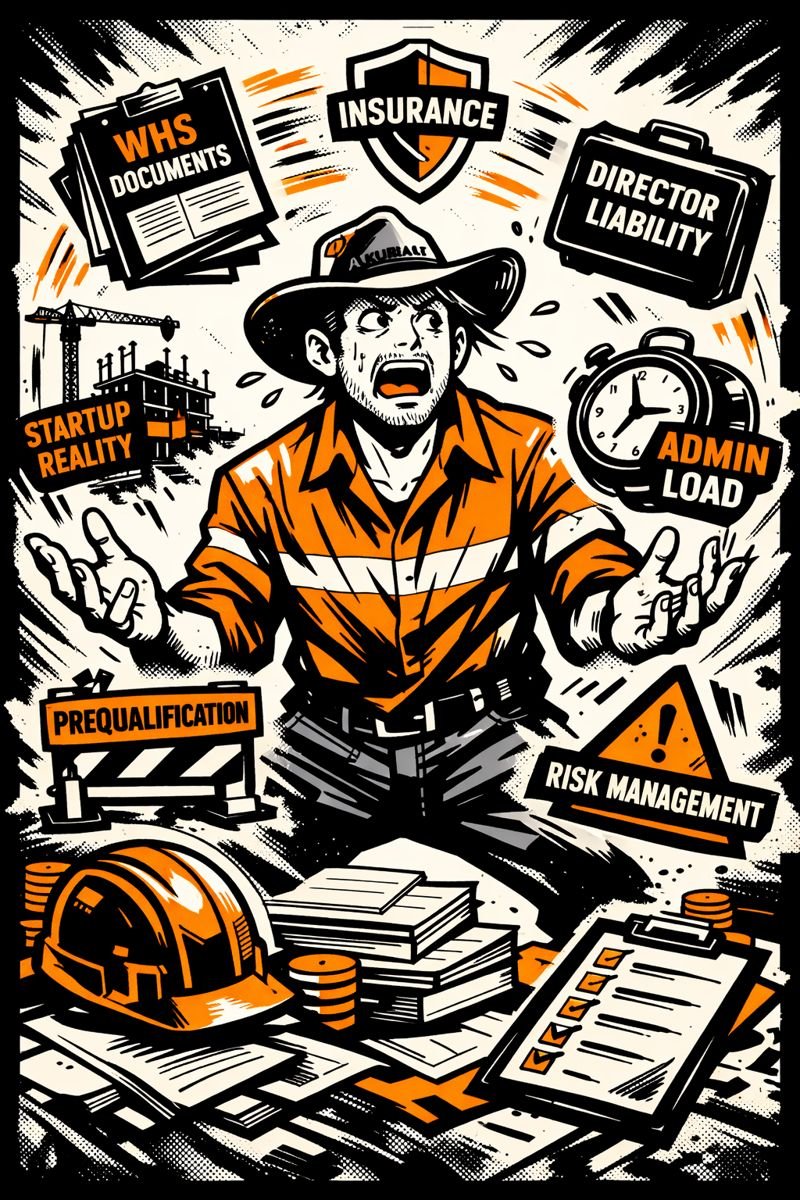
Why “I’ll Sort the Safety Stuff Later” Backfires
Delaying compliance feels logical when you’re under pressure. You’re focused on actual income generating activities which leads to:
Cashflow coming in.
Getting through the job.
Keeping clients happy.
Getting onto the next job.
But in construction, compliance isn’t optional.
It’s Risk Management.
Putting it off leads to:
Tenders you can’t win (which also doubles as a time sink to even submit them to start with).
Scrambling to write documents under deadlines repeatedly which leads to poor quality outputs.
Generic templates that get rejected. Think template AI slop shops.
Insurance gaps you only discover after an incident.
By the time you need proper documentation, you actually needed it yesterday.
The Hidden Cost Nobody Mentions: Time and Cognitive Load
The basic startup costs are easy to see. What’s not often talked about (or thought about) is the hidden admin and mental load.
Founders who are suddenly:
Writing safety documents at night to meet tenders or satisfy project or site requirements.
Having to guess what clients actually want in theses docs (and this can be quite subjective across different clients also).
Trying to interpret legislation they’ve never had to read and then how to apply it to your operations.
Rebuilding the same documents over and over for different tenders and projects which can be an incredibly slow process if typing on keys is not your thing.
Not only is this not the best use of the Founders extremely valuable time, it’s exhausting.
And exhaustion is where mistakes can happen.
Why Compliance Is Actually About Risk, Not Rules
At its core, compliance does one thing:
It transfers risk away from you personally.
Proper systems:
Reduce risk to your Workers!
Protect you as a company director.
Strengthens insurance defensibility (and potentially reducing insurance cost as a side benefit).
Reduce exposure after incidents and any potential as being labelled as negligent.
Make audits survivable instead of stressful.
This is often the part many people only learn after something goes wrong unfortunately.
Good documentation does not stop incidents by itself, it must be combined with training and proper Supervision (and other processes outside the scope of this article), but bad documentation (or worse no documentation at all) can make a bad day much worse with serious consequences under WHS legislation.
The Businesses That Survive Do One Thing Early
The contractors who make it past the first 12–24 months usually have one thing in common:
They stop treating compliance as an afterthought.
They:
Put minimum viable systems in place early.
Use documents that actually match how they work, not generic AI slop.
Build once, then reuse and improve over time.
Get help instead of reinventing everything.
Simply starting properly instead of patching later.
Where Most New Contractors Go Wrong
The most common mistakes I see:
Downloading generic templates that don’t fit the job, then realising they still need properly customising to suit the work.
Copying documents from other businesses without proper review (including formatting) which can
Writing policies nobody uses, knows about, which also can open the business to risk if poorly worded.
Treating compliance as a once off task just to win a job.
Compliance isn’t about having more documents.
It’s about having the right ones, structured in a way that clients and auditors recognise.
A More Sustainable Way to Start
If you’re thinking about starting, or you’ve just started, the smarter approach is:
Understand what’s actually required (and good news its not everything all at once!)
Put a basic but solid compliance foundation in place.
Scale up documentation as the business grows.
You don’t need ISO systems on day one.
You do need documentation that:
Gets you through tenders which the best chance to actually win.
Gets you on site and completing jobs.
Helps you grow into bigger jobs.
Protects you if something goes wrong.
Final Thoughts
Starting a construction business isn’t hard just because the work is hard.
It’s hard because you’re suddenly responsible for everything thats around the work.
Compliance is usually the first wall not because it’s impossible, but because nobody prepares you for it.
If you deal with it early and properly, it becomes a support structure.
If you ignore it, it becomes a constant source of friction.
Either way, it’s coming.
If you’re early on and just want to stop guessing, I’ve built a modular WHS document library designed specifically for small construction businesses. These are not generic templates, they have been honed over the years to be useable and reflect actual work being done. (That said they will still need to be adapted to your business).
It’s built so you can start with the minimum, then scale as the business grows from policies and SWMS and project specific plans all the way up to full system architecture manuals. Check it out here.
I also offer a WHS retainer if you need assistance with WHS setup and customisation of documents. Check it out here.
