The Best Business Tool Might Be the One You Build Yourself
I wasn’t trying to build software.
I was just trying to remove a few annoying bits of friction from my own workflow.
But after doing it a couple of times over the last few weeks, the pattern became pretty hard to ignore. There are a lot of tools out there that do useful things, and many of them are genuinely good products. The issue is that they often come bundled with a heap of additional functionality you don’t need, don’t use, and still end up paying for every month. Edge cases are literally built into the cost.
For a larger business, that might just be absorbed as another subscription.
For a small business, those little costs and workflow annoyances matter.
They add up. For all businesses.
And increasingly, I’m starting to think the better question is:
“Can I build the simple version I actually need in a way that I will use?”
Example One: Replacing a Mind Mapping Tool
I’ve been using Whimsical recently, mainly for mind mapping with occasional flow chart work.
It’s a good product. I was paying around $12 USD per month for it, and for what it does, that’s not outrageous. Its easy to use and you get a nice clean finish.
But most of what I needed for normal workflows was actually pretty simple.
I wanted somewhere to capture ideas visually, move things around, connect concepts, and keep thinking clear while I was working through content, systems, workflows or business ideas.
That was basically it.
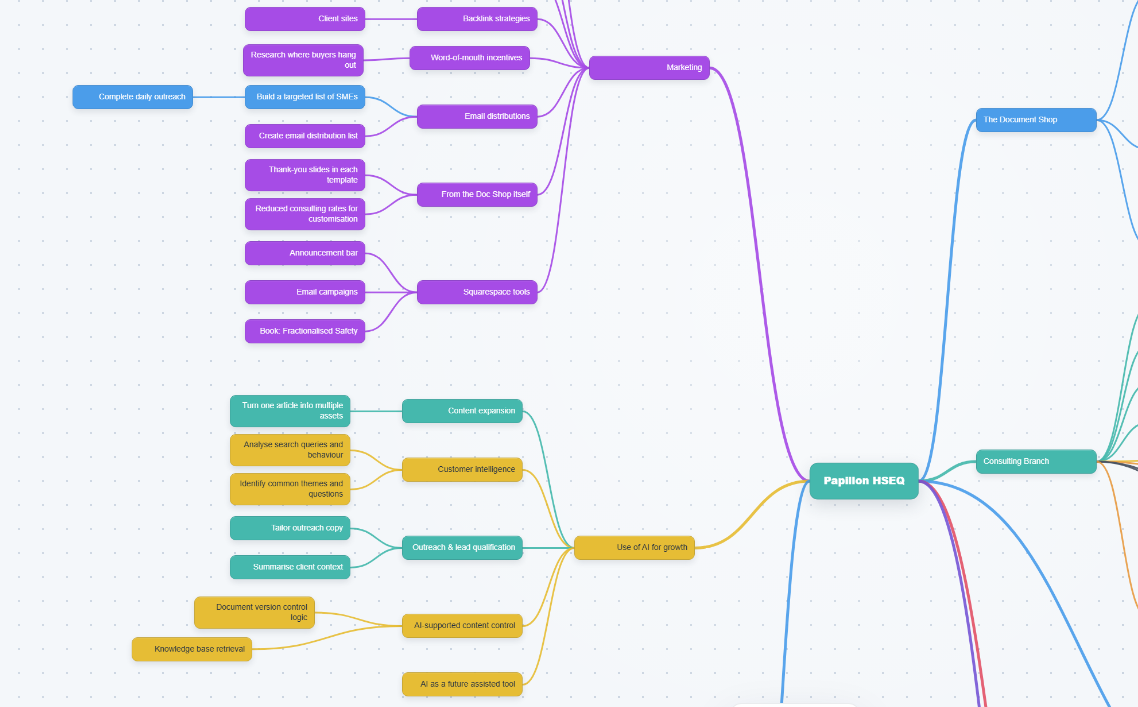
So, as a bit of a test, I asked GPT Work to help me build my own version.
Not a full Whimsical replacement. Just a simple mind mapping tool that did what I needed it to do.
And honestly, for my use case, the result is arguably better.
It doesn’t distract me with things I’m not using. It reflects the way I actually work, and it costs nothing beyond the setup time I put into building it which consisted of me dictating a prompt and letting GPT Work do its thing for half an hour.
The below image is from one of the working versions GPT Work built.
That’s the bit I think small business owners should pay attention to.
A lot of the time, we don’t actually need more software, we need less! Just simpler tools that fit the work.
Simple Is Underrated
There seems to be this assumption in business software that more features automatically means more value.
Often, it just means more menus, more settings, more subscriptions, more training, more admin, and more things for people to avoid using. More friction to use.
Small business owners don’t need enterprise-grade complexity for every problem. They often just need a bloody great big button that does one thing properly.
Click this.
Produce that.
Update the register.
Create the PDF.
Generate the report.
Move the idea.
Capture the action.
Or more recently, moving towards a big button that does all of the above.
That kind of simplicity is valuable because it reduces decision friction. People don’t have to think about the tool. They just use it and get back to work.
Especially important in small operational businesses where the person using the system is often also quoting jobs, talking to clients, managing people, doing admin, dealing with compliance, chasing invoices and trying to keep the wheels turning.
Every extra unnecessary step matters and compounds negatively over time…
Example Two: The Adobe Moment
The second example came while I was working on a document control management system manual.
I wanted to include that example because this is the kind of work I actually do: building and improving management system components, including things like document control, HSEQ system frameworks, structure, registers, workflows and supporting processes. Basically, I have built basically every component of a whole ISO aligned and compliant system - before the advent of AI as well!
Anyway, as part of that work, I was rendering some content into PDF.
I opened the PDF in Adobe Acrobat and needed to rotate the document.
Nothing fancy.
Just rotate the document.
So, I did the normal right-click rotate action in Windows, and Adobe popped up telling me I needed to upgrade to rotate the file.
To rotate a PDF. That annoyed the absolute $h1t out of me.
I’ve used Adobe Pro before, and I understand paid software has its place.
But there is something particularly frustrating about being blocked from basic functionality that should just be part of normal document handling. I’m not paying $240 a year just to rotate a document or rearrange pages.
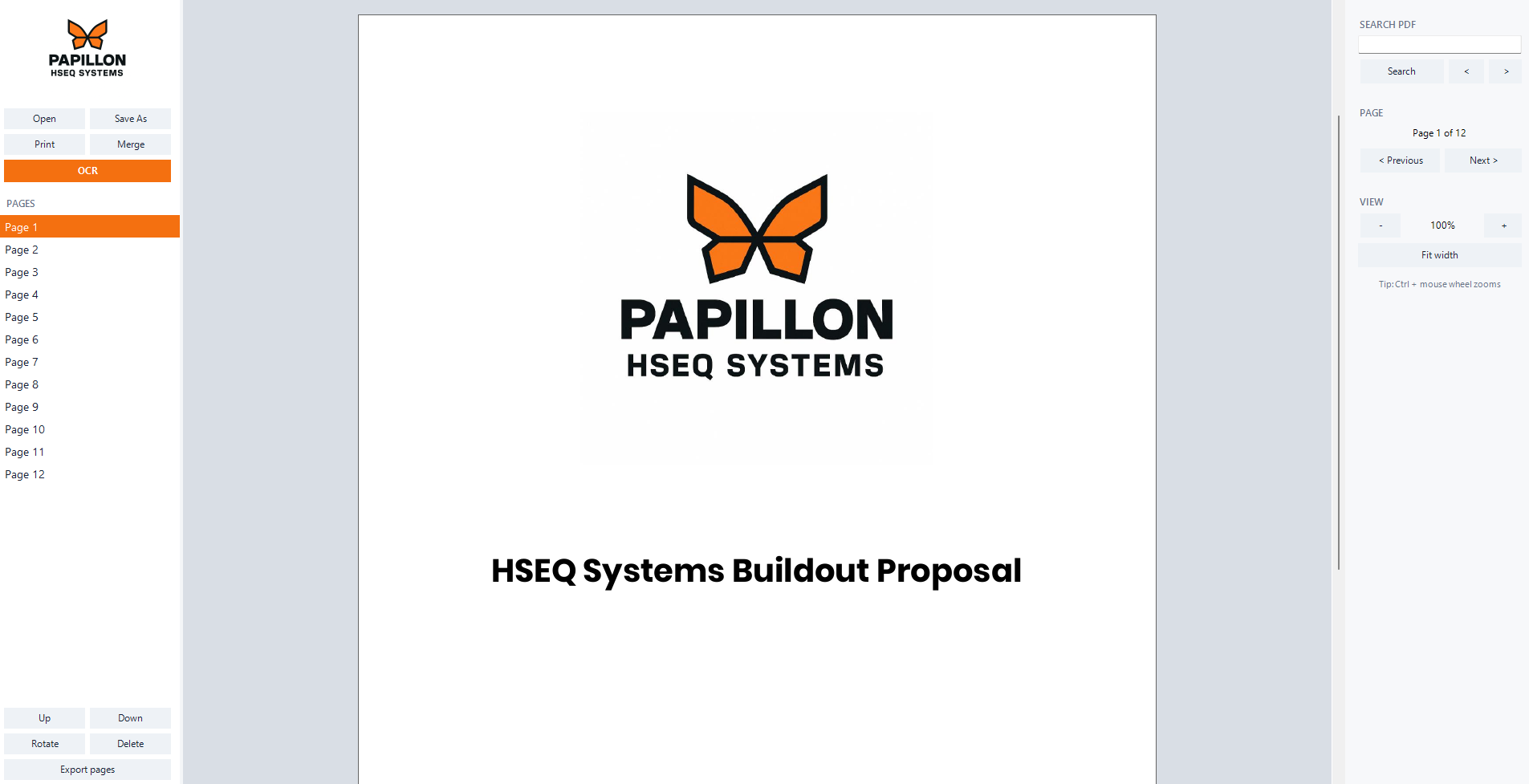
So I asked GPT Work to help me build my own basic PDF Studio. (See image below)
I don’t need every feature Adobe has ever created. I just needed a simple internal tool that could do the basic things I regularly need to do with PDFs, without being pushed into an upgrade path every time I click something useful.
That is the bigger point.
I built them because the workflow friction became annoying enough that building around it made more sense than continuing to accept it.
Saving $500 per year and getting a custom product is also a good motivator.
Legacy Providers Are Going To Have A Problem
A lot of legacy software providers have built their model around lock-in.
Once your business is inside the tool, they know it’s painful to leave. So you end up accepting the pricing, the limitations, the extra modules, the upgrade prompts, the price creep each year, the feature gating and the clunky workflows because moving away feels harder than staying.
That worked when businesses had very few alternatives.
But AI is starting to change that and real fast.
Not because every business owner is suddenly going to become a software developer.
They won’t.
But the barrier to building simple internal tools has really collapsed now.
If you can clearly explain the workflow, the friction point, and what you want the tool to do, it is now possible to build useful internal tools at a speed and cost that would have been unrealistic not that long ago.
That does not mean every tool should be custom built. Some software is absolutely worth paying for.
But small businesses should probably start questioning which subscriptions are genuinely adding value, and which ones are just hanging around because nobody has looked closely enough at the workflow.
This Applies Directly To HSEQ And Management Systems
This is where it gets very relevant to HSEQ, compliance and management systems.
There are plenty of legacy health and safety management systems charging serious money for functionality that many small businesses either barely use or don’t actually need.
A lot of these elements can now be rebuilt, digitised, simplified or AI-augmented for a fraction of what businesses have been paying.
As in, you pay $20k per year for something you can probably either build yourself or with some assistance from someone like myself and save some serious coin.
More importantly, they can be built around how the business actually works AND you get to retain your ownership and control of the system you are using.
And remember once you have built your own custom tools, system there’s no more ongoing licensing costs. $20k saved over 5 years is money that can be applied to physical assets, like a couple of Komatsu’s for example.
Because one of the biggest problems with management systems is not that businesses don’t have enough documents, forms or registers.
It is that the systems are often too clunky, too generic or too disconnected from the reality of the work.
Some of the legacy providers refuse to adapt and step outside of what they are providing.
Adapt or die.
The Real Question
“What friction are we actually trying to remove?”
Once you understand the friction, the solution often becomes much clearer.
Maybe you do need a proper platform.
Maybe you need a custom internal tool.
Maybe you need a better register.
Maybe you need a workflow rebuilt.
Maybe you need an AI-assisted process sitting behind something that used to be manual.
Maybe you just need one simple button that does the annoying thing properly.
The point is to stop accepting unnecessary cost and complexity as normal, especially when its possible to cook some useful software yourself (or with a dash of help).
Final Thoughts
AI can help small businesses build practical tools around their own workflows.
Custom. Simple. Useful tools.
Tools that reduce admin friction and no longer require a monthly subscription just because the market has decided every tiny function now needs to be monetised.
For small businesses, that could become a real competitive advantage, especially before others learn about this.
More time back.
Lower overheads.
Faster workflows.
Less dependence on legacy providers.
More control and flexibility over how the business actually operates.
I’ve been applying concepts like this directly in my own work for months at this point, the ROI for me (in time especially) is staggering.
If your business needs help with management system components, HSEQ system elements, document control, digitisation, or building practical AI-augmented workflows, get in touch.
Maybe you just need a simple tool built properly around the way your business actually works.
