Your Website Might Be Invisible and You Wouldn’t Know It
A lot of small businesses have a website and mentally tick the box.
They paid someone to build it, or built it themselves, added the service pages, uploaded a few photos, connected a contact form and assumed the basic online presence was handled.
And to be fair, why wouldn’t they?
Most business owners are not sitting there thinking about Google Search Console, Bing Webmaster Tools, sitemaps, indexing, crawl status or whether Google has actually recognised the pages they think are live.
In many cases, they might never log into Search Console directly at all. They might use a website provider, hosting platform or plugin that says something like “submit sitemap,” click the button, and assume that is enough.
I set up www.papillonhseq.com via both the hosting platform and Google Search Console.
I was adamant I had submitted the sitemap properly when I first set things up. I remember logging in, going through the process, submitting what I thought was the correct sitemap in the correct place and then moving on.
In my mind, that job was done.
From there, my next job was to keep building out the website, create content, add products, refine service pages and let the crawling and indexing process take care of itself in the background over time.
That it turned out was a mistake.
Fast forward four months.
Months of creating content, building out service pages, adding products gradually to the document shop and generally trying to improve business visibility, I logged back into Google Search Console and realised the website was barely visible.
Only six pages were actually indexed and doing anything meaningful.
Six.
Bloody hell.
And of those pitiful six pages, one of them was a heat stress poster, which is a $9 product and probably one of the least valuable things on the website from a consulting business point of view.
I was extremely frustrated to put it simply.
If you are trying to build visibility for consulting work, retainers, WHS support, HSEQ systems, fractional management and actual service-based enquiries, having one of your few visible pages be a low-value poster is not exactly ideal.
Nothing looked wrong from the outside. The website was live. The pages existed. The articles were published. The products were there. From a normal user’s point of view, the business had a functioning online presence.
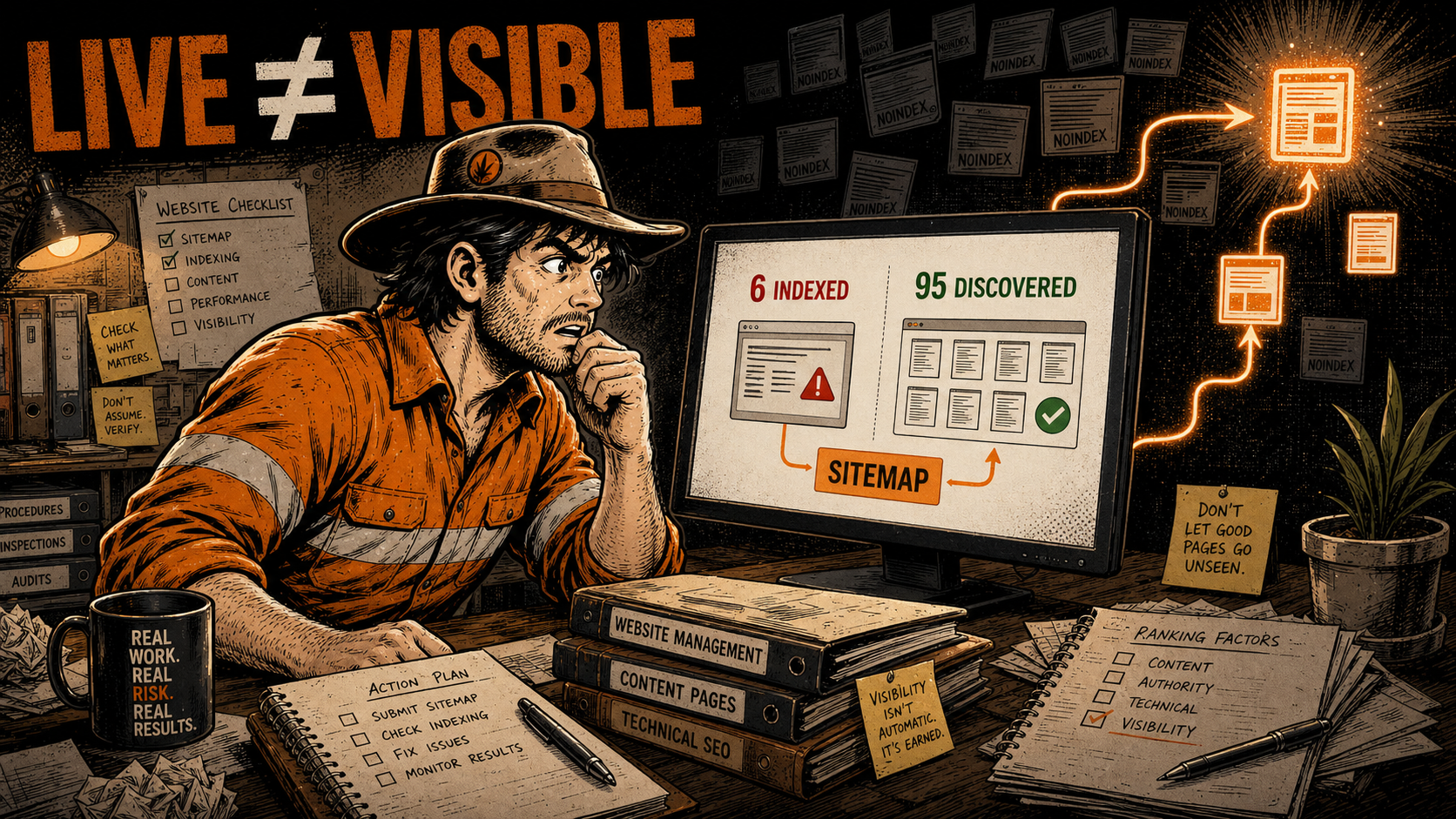
But inside Google Search Console, the picture was very different.
The sitemap either had not been submitted in the right place, had not been recognised properly, or had not been checked properly after the fact. Whatever the exact technical cause was, the practical outcome was the same.
Google was only seeing a small portion of what I thought was available and I had lost 4 months of progress of where the SEO should actually be.
When I submitted the correct sitemap again, Google immediately identified roughly 95 pages available for crawling.
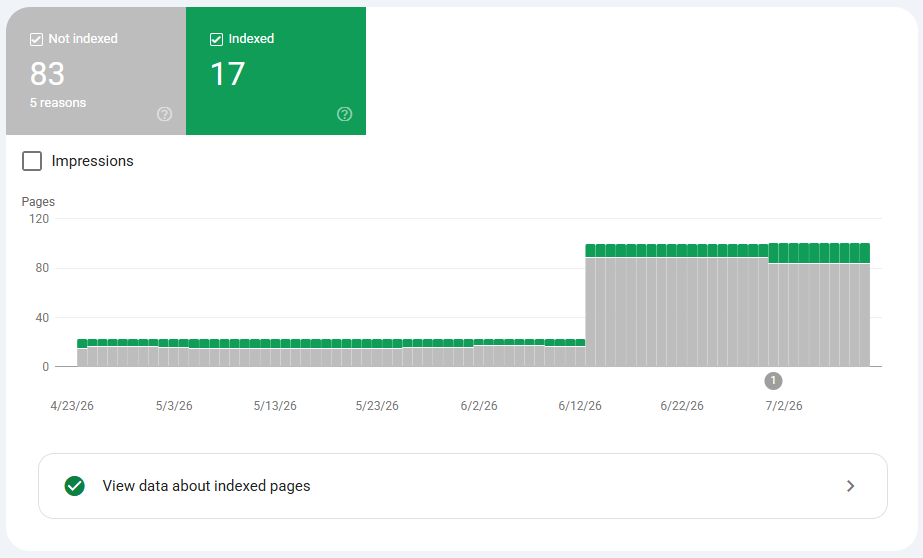
After resubmitting the sitemap, now more time to wait for recrawls from Googlebot…
A massive mismatch… and in search, four months is not nothing, especially for a fledgling consultancy.
SEO, indexing and discoverability are certainly not instant processes. You cannot flick a switch and immediately get meaningful visibility, especially as a small business. So when you lose months because a basic submission or monitoring step was wrong, the impact compounds quietly (and negatively) in the background.
I had been wondering why there was so little movement from organic search. Why the website was not generating much in the way of cold inbound enquiry. Why the content and product work did not seem to be creating much visibility.
The answer may have been brutally simple. A lot of it was not properly visible in the first place.
And this is the part I think matters for other small businesses. If I can miss this while actively working on my own visibility, I suspect a lot of others can as well.
Most business owners would not know this was happening.
In fact, I would assume many have never logged into Google Search Console at all.
They would assume the website was live, therefore searchable. They would assume that because they paid for the website, added content, or had someone “set up the SEO”, the basics were covered.
They might still get some traffic from people who already know the business name, and that creates a false sense of security. But being found by people who already know your name is not the same as being discoverable.
There is a big difference between someone searching for your exact business name and someone searching for the service you provide.
Take an excavation contractor as an example. They might appear if someone searches the company name. Great. But if someone searches for excavation contractor near me, trenching contractor, driveway excavation or site cut contractor, and the business does not appear, then the website is not really functioning as a business development tool.
It is functioning as a digital business card for people who already know where to look.
Warm contacts can carry you for a while. Referrals can carry you for a while. Existing relationships can carry you for a while. Most of my work still comes through warm contacts, which is fortunate.
But eventually, no matter if the goal is growth, resilience or a better pipeline, some level of cold inbound discovery matters.
People need to find you before they know you.
The hard thing for small business owners is that SEO has become an incredibly noisy space. There are thousands of people willing to sell you SEO. Some of it is legitimate, some of it is useful, and some of it may be necessary once a business reaches a certain stage.
But before worrying about the advanced layers, there is a much simpler question:
Has the website actually been submitted, indexed and monitored properly?
Because if the answer is no, then a lot of the higher level SEO conversation is irrelevant, like worrying about the paint colour on a truck that has no fuel in it.
For a small business, the basics do not need to be complicated.
Google Search Console should be set up.
Bing Webmaster Tools should be set up.
The sitemap should be submitted properly.
The sitemap status should be checked after submission.
The main pages should be indexed, and impressions, clicks and search terms should be reviewed occasionally. (Read more than every four months!)
That does not mean obsessing over SEO every day. But it does mean treating website visibility as something that needs checking, not a one-off setup task.
Search Is Changing FYI
There is also another layer to this now, because search is changing. People are not only using Google in the old way anymore. They are asking AI tools to find, compare, summarise and recommend businesses.
I did this myself recently. We had a burst 20mm copper water service on the house feed just before selling it (bloody murphy’s law right…), and I did not go to Google and manually search through plumbing businesses. I used AI.
It summarised plumbing businesses in my suburb, gave me recommendations, and I called the first one that looked suitable and was contactable on a Saturday.
When this business asked how I found them on the call, I told them they were the first one AI had summarised for plumbing businesses in my suburb. They were genuinely surprised by that.
This behaviour isn’t going away. It is going to become more common.
People will increasingly ask AI tools who can do a job near them, which business offers a service, who looks credible, who works in a particular area, or which contractor seems suitable. AI will then summarise the options.
That then also changes the question for small businesses in relation to search. It is no longer just, “Can Google find my website?” It is also becoming, “Can AI understand what my business does clearly enough to summarise it?”
That is where clean site structure, clear service pages, local relevance, useful content and schema code specifically written for AI start to matter making it easier for search engines and AI tools to understand who they are, what they do, where they operate, who they help and what services they provide.
I do not think every small business needs to become a technical SEO specialist. But they should understand the general direction of travel. The businesses that get the basics right early may build a small visibility advantage against their direct competition.
That is not just marketing alone. That is digital discoverability.
After finding my own issue, I updated my own operational shortcut menu so Google Search Console is now 2 mouse clicks to access and check. Sounds minor, but it matters, because systems that are hard to access do not get reviewed.
The review does not need to be complicated. It can be as simple as checking whether the sitemap has been read successfully, whether the main pages are indexed, investigating reasons others are not, whether impressions are increasing, whether clicks are moving, what search terms are showing up, and whether the right pages are being surfaced instead of the lowest value products….
That last point is poignant, because visibility is not just about more traffic. It is about the right traffic.
The uncomfortable truth is that a business can be doing good work, offering valuable services, publishing useful content and still be largely invisible online because one basic system was not checked.
Sometimes the answer is simply to check the thing you assumed was working!
