Why Experience Becomes More Valuable as AI Gets Better
For most of recorded modern working history, technological change followed a familiar pattern.
New tools improved productivity, rewarded speed, and lowered the cost of execution.
Organisations that could move faster, cheaper, and with more energy gained an edge.
In that environment, experience often appeared to lose value over time.
Youth was equated with speed and adaptability usually at low cost.
Seniority (read age) was associated with higher costs and often also a reduction in speed (read output).
Labour has always been the best lever you can pull as some would say, and hiring (or firing) decisions reflected that logic.
AI and increasingly robotics in my opinion are going to fundamentally break that model.
The Old Value Equation (And Why It Once Made Sense)
For decades, the economics of work followed an unspoken equation:
Youth = Speed.
Speed = Productivity.
Productivity ÷ lower wages (paid to youth) = Value gap (profit)
Younger workers were faster, required less remuneration, and could produce more output per dollar.
When execution was the bottleneck, this logic was rational.
It isn’t kind, but it was efficient. This is how informal age cut-offs emerged across industries. They weren’t usually written down, but they were understood. They functioned as crude proxies for speed, energy, and output.
I have witnessed my own dad be replaced by youth. It wasn’t personal they told him, it was just business.
In a linear world, this theory works pretty well.
Why That Equation Breaks Under AI and Robotics
AI changes the economics of cognitive execution.
Robotics changes the economics of physical execution.
Together, they remove the historic advantages that underpinned the old model:
AI drafts, synthesises, compiles, analyses, and produces first pass outputs in literal minutes.
Robotics handle repetition, endurance, precision, and physical loads.
Execution becomes faster, cheaper and more abundant.
However, when execution is no longer scarce, it ceases to be the primary source of value.
Those labour levers now matter much less from an actual output perspective.
Which then raises a different question:
If execution becomes cheap, what then are organisations actually going to pay for to create value when the arbitrage game of labour costs vs output is gone?
What Becomes Scarce Instead
As AI and robotics compress execution, what becomes valuable is judgement.
Not judgement in the abstract, specifically applied judgement under real constraints. Read: Experience.
Knowing when something “technically correct” is still wrong.
Understanding downstream (or related adjacent) consequences.
Calibrating decisions to context.
Anticipating failure pathways before they surface in order to adapt or mitigate the likelihood.
These are not skills that scale cleanly with tools.
They compound through exposure.
Experience doesn’t make people faster. It makes them harder to surprise.
What This Means for Veterans and Long-Tenured Staff
This shift has a practical implication that many organisations have not yet fully confronted:
Their highest latent value may already be on the payroll.
The veterans and long tenured Workers often sit in an uncomfortable middle ground.
They are no longer the fastest executors.
They are sometimes treated as higher cost centres rather than leverage points.
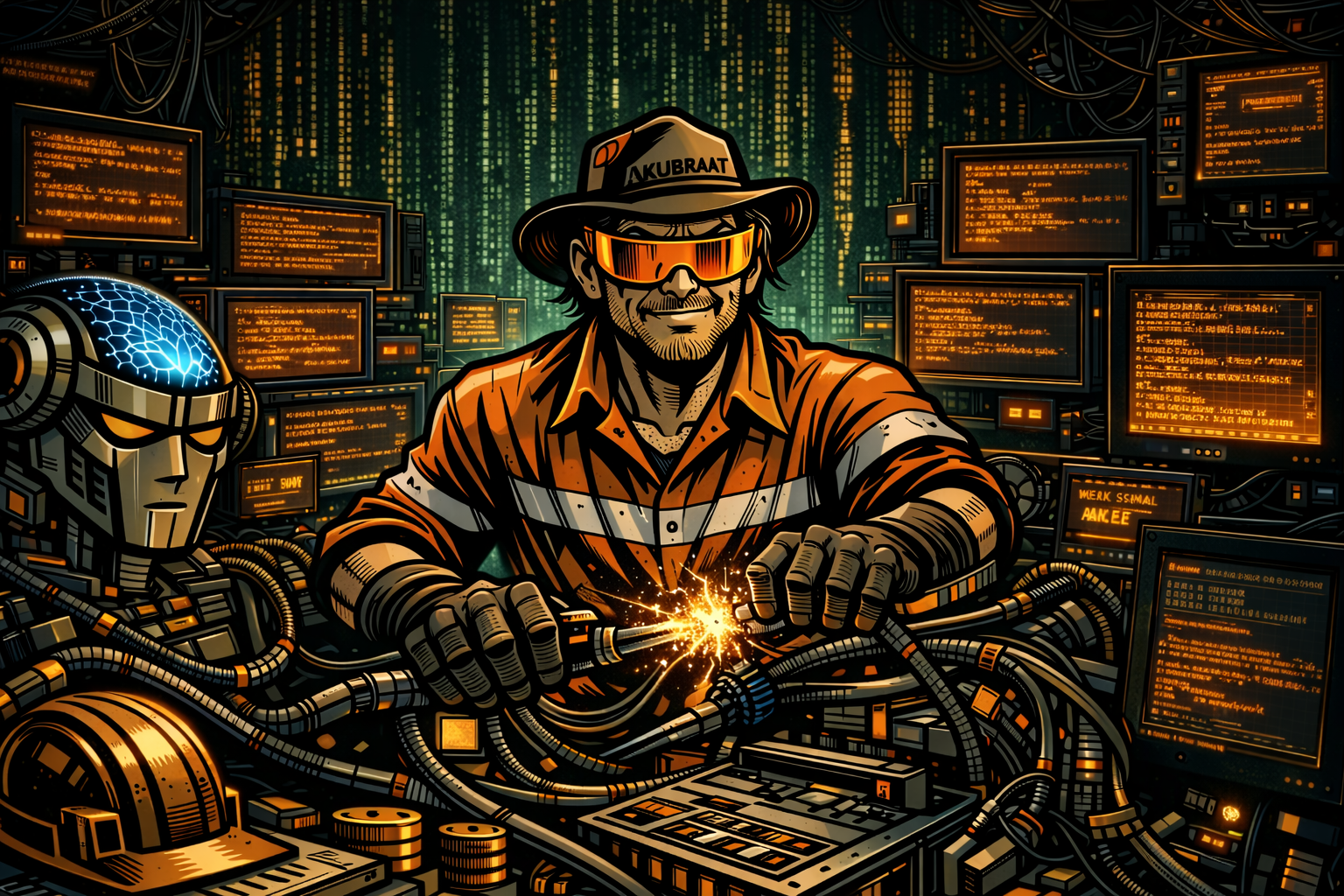
I posit that, as AI absorbs execution, these individuals become inherently and uniquely valuable moving forward. Not because they do more work, but because they know where work breaks, bottlenecks and how systems, subsystems and people interrelate.
They carry:
Institutional memory of near misses and other failures that never made it into incident reports.
Intuition for which rules matter and which are just policy and compliance waffle.
Pattern recognition built across business cycles, regime and leadership changes within the business.
An internal map of how decisions actually propagate through the business.
This is of course, is exactly the context AI lacks, and can only be learned from experience and relationships built over time.
AI can generate outputs. Veterans can potentially weld and meld those outputs into a functioning reality to provide value.
They know when to trust models, when to override it, when to correct it, when to point out that a key step is missing.
They know which edge cases matter and what outcomes may occur. And of course, it’s always the edge cases that catch people out and can result in a whole raft of negative outcomes, reworks, loss of contracts and so on.
In an AI-enabled organisation, veterans are no longer competing with tools. They are becoming the interface layer between tools, consequences and creating new forms of value.
Organisations that prematurely hollow out this cohort in pursuit of wage optimisation (read cost savings) may ultimately find themselves with powerful systems with no one left who knows how to apply them safely, credibly, to properly execute work.
Why the Wage Argument No Longer Holds
Lower wages only create value when:
Mistakes are cheap.
Rework is tolerable.
Consequences are delayed or hidden.
Scrutiny is low.
AI flips this dynamic.
When outputs are produced faster and at scale:
Errors propagate further before detection.
Systems fail more cleanly and more publicly.
Post-incident scrutiny intensifies.
Responsibility concentrates upward.
In that environment, the most expensive thing is no longer salary.
It’s:
Regulatory exposure.
Insurance defensibility.
Reputational damage.
Operational shutdowns.
Decisions that don’t survive hindsight.
Optimising for lower wages while increasing exposure becomes a false economy.
The “But Who Cares? This Is 10 Years Away” Misconception
A common response to AI and Robotics is that their impact on jobs is still a decade away.
This misunderstands how disruption actually arrives.
Jobs are not replaced when technology is perfect. They are reshaped when expectations change.
Part of why this shift is consistently misread is cognitive.
Humans Don’t Think Exponentially, and that’s the trap
Look at almost any demand forecast:
Smooth curves or steps.
Steady growth.
Incremental compounding over a decade.
Most humans think linearly. Those charts feel reasonable. They feel safe.
But technology adoption doesnt behave that way.
Once a technology crosses a viability threshold, adoption accelerates non-linearly.
Expectations reset faster than organisations can re-plan.
AI has an adoption model faster than the internet, change is coming, fast.
It won’t be here in 10 years or even 5.
Next year will look very different from this one.
A Real Example: Lithium Demand
I saw this exact error play out years ago with lithium demand forecasts.
Around 2015, analysts produced clean, linear projections stretching well into the future.
The charts made sense if you assumed gradual adoption.
But the underlying driver, electrification, wasn’t linear.
It was exponential. Solar panel uptake and the advent of Tesla and the birth (well rebirth) of the electric car industry.
Once electric vehicles crossed a credibility and economic threshold, demand didn’t grow steadily.
It cascaded.
The forecasts weren’t wrong because of bad maths.
They were wrong because of incorrect assumptions about the breadth of change.
The same mistake is again being repeated with Lithium from demand from battery storage solutions.
The same mistake is now being repeated with AI and Robotics.
AI and Robotics Don’t Replace Jobs, They Hollow Them Out
AI and Robotics don’t usually eliminate entire roles overnight.
They remove parts of jobs:
Repetitive execution.
First drafts.
Baseline analysis.
Physical repetition.
Once those parts disappear:
Junior roles shrink.
Entry pathways collapse.
Leverage shifts upward.
Decision-making becomes more visible.
By the time replacement looks obvious, the labour model has already changed.
A Generational Layer (Without the Noise)
This shift doesn’t reward age or youth. There is a group right now that sits in a particularly strong position:
Enough experience to recognise failure modes.
Enough curiosity to adopt new tools properly.
Still close enough to execution to stay grounded.
In practice, this often describes people in their late 30s to mid-40s, The Millennials.
Complementary Strengths, Not Competition
This doesn’t diminish younger groups.
Gen Z is exceptionally well positioned to:
Build AI tools.
Push interfaces forward.
Experiment rapidly.
Iterate without legacy bias.
Millennials are often better positioned to:
Apply those tools to messy real-world environments.
Integrate them into systems.
Judge adequacy vs overkill.
Manage the consequences.
Senior experience adds oversight and defensibility.
The Quiet Shift Already Underway
Organisations aren’t asking:
“When will AI replace this role?”
They’re asking:
“Why does this role still require this many people?”
That question is already reshaping:
Hiring plans.
Wage bands.
Promotion paths.
Graduate intake.
Team structures.
Quietly.
Incrementally.
Exponentially.
The Refined Thesis
AI and Robotics don’t reward youth or age.
They reward people with enough experience to judge outcomes and enough adaptability to use the tools properly.
Right now, that happens to describe a lot of Millennials.
That window won’t last forever as AI assimilates experience over time.
But it is very real right now.
Final Thoughts
AI doesn’t remove the need for humans.
It removes the need for humans who only execute.
As technology gets better at doing work, the value of experience compounds.
Because responsibility, judgement, and consequence remain stubbornly human and they always arrive after the output.
