Fractional HSEQ Management: Why SMEs Need Management-Level Safety Judgement (Not Just Advice)
Much of what businesses call “safety work” is not advisory work at all.
It is management work.
And when that distinction is blurred, small and medium construction businesses end up with:
Fragmented systems.
Inconsistent decisions.
Reactive compliance.
A false sense of control until something goes wrong.
Fractional HSEQ Management exists to address that gap.
The Reality SMEs Are Operating In
Small and mid-sized construction businesses sit in a problematic position.
They:
Carry the same WHS duties as larger organisations.
Are judged by the same regulators, clients, and auditors.
Face increasing documentation and system expectations.
But do not have the scale (or resources) to justify a full-time HSEQ Manager.
At the same time, the traditional options available to them don’t fit particularly well either:
Templates can reduce admin, but don’t apply judgement.
Advisors can be valuable on site, but don’t usually design systems.
Consultants can solve isolated problems, but don’t maintain continuity across the business.
What’s missing is management-level oversight that is proportional to the size of the business.
That is the problem fractional HSEQ Management is designed to solve.
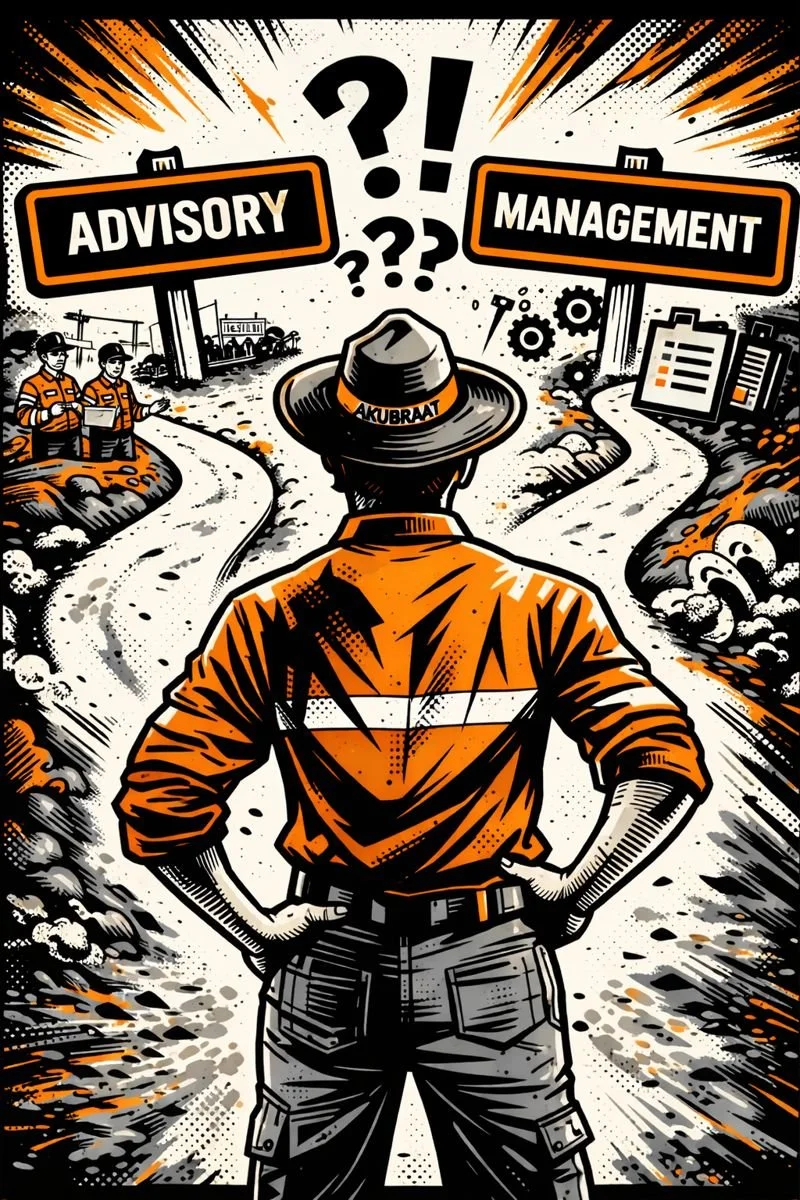
The Critical Distinction: Advisory Work vs Management Work
Advisory work is execution focused. It includes:
Applying existing procedures and processes.
Supporting site compliance such as inspections.
Coaching Workers and Supervisors.
Observing work and reinforcing controls.
Administer systems that already exist, for example run an induction.
Good advisors are invaluable once a system is in place.
But advisors generally operate within a framework, they do not design it.
Management work is different.
HSEQ Management involves:
Designing the structure of the system.
Deciding what is mandatory vs deferred, that is priorities of system build outs.
Calibrating depth based on risk and client expectations.
Aligning documentation to standards and best practice without overbuilding
Deciding how much is “enough” at each stage of business maturity.
Owning the logic behind decisions, not just the documents.
This is judgement-based work.
It is not about hours.
It is about management of risk over time.
A Real-World Example of the Problem (From a Recent Job Advert)
A good way to see this distinction break down in practice is to look at how HSEQ roles are commonly structured.
Recently, a job advert was released for a WHS&E Advisor role within a construction business. It was a well-written, serious role description, and representative of what the market currently expects.
Paraphrased, the role required one person to:
Provide day-to-day safety support across multiple sites.
Conduct inspections, audits, Prestarts, and toolbox talks.
Maintain training records and onboarding documentation.
Collect and report safety statistics and KPIs.
Develop and maintain project HSE Management Plans and risk registers.
Chair Construction Risk Assessment Workshops (CRAWs / HAZOPs).
Investigate incidents and manage reporting.
Interpret major client and principal contractor requirements.
Maintain systems aligned to ISO 45001.
Drive “continuous improvement” initiatives.
Assist with injury management and return-to-work processes.
There is nothing unreasonable about any one of these expectations.
The issue is that they span three very different layers of work.
The Three Layers Being Bundled Into One Role
When you step back, what’s being asked of this single role is:
1. Execution / Advisory Work
Site presence.
Workforce engagement.
Applying controls.
Coaching and influence.
2. System Administration
Registers and records.
Training coordination.
KPI tracking and reporting.
Document upkeep.
3. Management Level Judgement
System design and structure.
Deciding adequacy of controls.
Calibrating risk treatment.
Interpreting client and regulator expectations.
Writing HSEQ Management Plans.
Chairing CRAWs with defensibility in mind.
Deciding what “good enough” actually looks like.
In larger organisations, these layers are always separated.
In SMEs, they are often bundled into one role, and this is where strain appears. Not because the individual is incapable, but because management work is being forced to compete with execution for time and attention.
HSEQ roles are often pulled into adjacent functions, HR, onboarding, training coordination, injury management because no other management layer exists to absorb that work.
The result is less time spent on the very activities that determine whether the system holds together over time.
So back to the job posting, there’s also a bit of a disconnect where the company wants HSEQ management work on an advisor salary. Of course, there are advisors who can grow into this role over time, but most people who encompass these skills (or at least do them well) are already employed as you guessed it…. HSEQ Managers.
Why Management Is Often Needed Before Advisory Execution
In many SMEs, the mistake is sequence.
Businesses often try to:
Bring in advisors.
Buy templates.
Patch gaps either on the fly or reactively (for example in response to a tender requirement or specific client requirement).
Hope it holds together.
An old colleague used to love the expression we are “building it as we are sailing it”.
But without management level design up front:
Advisors are forced to improvise on the fly.
Documentation becomes inconsistent over time. Buy one template here, and another there, etc…
Supervisors interpret requirements differently.
Systems drift as the business grows.
Advisors aren’t actually engaged where they are most valuable…at the coal face.
Fractional HSEQ Management flips the sequence.
First:
Design the system.
Align it to meet the needs of the business!
Define expectations clearly.
Decide what system components matters now and what can wait until later.
Then:
Advisors can execute with focus within a structured framework.
Supervisors can administer the system properly across any job.
Compliance becomes predictable instead of chaotic.
The Transitional Nature of the Model (This Is Important)
Fractional HSEQ Management is not intended to grow forever.
If it’s working properly, the required management hours should actually reduce massively over time.
As systems mature:
Structure stabilises.
Documentation becomes modular.
Expectations are understood.
Decision logic is established.
At that point, businesses naturally transition toward one of three models:
Fractional HSEQ Manager (low hours) + full-time advisor(s) on site.
Fractional HSEQ Manager + trained Supervisors administering the system.
Fractional HSEQ Manager only, where risk profile allows, for example lower risk environments.
This is a feature of fractional HSEQ.
The goal is not dependency.
The goal is sustainable control.
System Design Is Not an Automatic HSEQ Skill
Not all HSEQ practitioners are system designers.
System design requires:
Adapting design principles to meet the needs of the business.
Understanding standards without blindly copying them.
Structuring systems so they can scale.
Designing processes people will actually use.
Balancing compliance, usability, and risk.
Knowing where over-complexity creates more risk.
Many practitioners are excellent at:
Enforcing systems.
Operating within them.
Advising on specific controls.
Far fewer are skilled at architecting the system itself.
Fractional HSEQ Management explicitly includes this capability.
Standards Alignment Without Gold-Plating
A common SME failure mode is either:
Doing far too little.
Massively overbuilding systems they can’t maintain later.
Fractional HSEQ Management sits between those extremes.
The focus is on:
Alignment to standards and recognised best practice.
Proportionality to size, risk, and resources available.
Credible documented progression towards compliance.
Demonstrable continuous improvement.
Not perfection on day one.
This matters because:
Auditors accept trajectory and visible progress.
Clients accept maturity when it’s honest.
Regulators look for reasonableness and practicality, not volume.
Where Responsibility Sits (And Always Will)
No model changes this.
Under WHS legislation:
Responsibility sits with the business.
And with the officers of that business.
Fractional HSEQ Management does not transfer responsibility.
What it does is ensure that responsibility is:
Supported by experienced judgement.
Exercised deliberately.
Documented coherently.
Defensible if scrutinised or needed to be relied on later.
If something goes wrong, the question is never:
“Who wrote this document?”
It is:
Were decisions reasonable?
Was risk understood?
Was oversight present?
Does the system make sense in hindsight?
Why a Retainer Model Makes Sense
This model does not work episodically.
Risk does not operate on project schedules.
Systems do not fail all at once.
They drift over time.
A retainer exists because:
Context matters.
Memory matters.
Decisions compound.
Oversight must be continuous.
Hourly consulting pays for tasks.
Retainers pay for continuity of judgement across time.
That distinction is critical.
The Role of AI (Supporting, Not Replacing)
AI has changed how fast systems can be built and refined.
Used properly, AI:
Accelerates drafting.
Reduces admin friction.
Improves consistency.
Increases ROI on senior input.
What it does not do is:
Decide adequacy.
Understand client nuance.
Judge risk tolerance.
Carry accountability.
In a fractional management model, AI amplifies experienced judgement it does not replace it.
Who Fractional HSEQ Management Is For
This model fits businesses that:
Are growing past ad-hoc compliance.
Work for clients with real expectations.
Want fewer surprises.
Value judgement over volume.
Understand that safety decisions compound and carry risk.
It is not suited to businesses that:
Want the cheapest solution.
Only care about ticking boxes.
Expect responsibility to sit elsewhere.
Are unwilling to engage with risk honestly.
That clarity protects both sides.
Why This Model Is Emerging Now
Fractional HSEQ Management wasn’t viable a decade ago.
It is now because:
Systems can be designed to be modular.
Documentation is reusable and adaptable at improved speeds.
AI reduces execution cost.
SMEs face greater scrutiny.
Full-time roles are often unjustifiable from a resource perspective.
What hasn’t changed is responsibility.
Fractional HSEQ Management exists because it reconciles:
SME economics.
Modern tools.
And non-delegable WHS duties.
Fractional HSEQ Management is not outsourced safety.
It is not part-time advice.
And it is not consulting by another name.
It is management-level HSEQ judgement, applied proportionally, and sustained over time.
For many construction SMEs, it is the first model that actually fits the reality they are operating in instead of forcing them into options designed for organisations they don’t resemble.
How Papillon HSEQ Systems Delivers Fractional HSEQ Management
Papillon HSEQ Systems provides Fractional HSEQ Management on a structured retainer basis.
The focus is not hours.
It is continuity of management-level judgement.
A typical fractional engagement may include:
• Initial system architecture review and maturity mapping.
• Risk-based prioritisation of system build-out or rebuild.
• Development or rationalisation of core management documentation.
• Alignment to WHS legislation and relevant standards (including ISO frameworks where required).
• Ongoing oversight of advisors and supervisors administering the system.
• Review of major client requirements before submission.
• Chairing risk workshops.
• Incident oversight and decision review where needed.
• Strategic input into resource allocation and system scalability.
This operates alongside:
• Existing site-based advisors.
• Supervisors administering procedures.
• Internal administration staff.
• External auditors or certifying bodies.
The objective is simple:
Build a system that makes sense.
Ensure decisions are deliberate.
Reduce surprises over time.
Engagements are structured to reduce in intensity as systems stabilise.
If This Resonates
If your business is:
• Growing past ad-hoc compliance.
• Feeling system strain.
• Bundling too much into one advisor role.
• Or preparing for larger clients and increased scrutiny.
A short diagnostic conversation is often enough to determine whether fractional HSEQ management is appropriate, or whether another model makes more sense.
You can:
• Get in contact to discuss a structured retainer model.
• Or explore the Papillon WHS Document Shop if your immediate need is targeted system components.
Either way, the goal remains the same:
Proportional, defensible, management-level HSEQ delivered at reasonable costs.
