I Am My Own Bottleneck
A few weeks ago I wrote an article called Experience That Lives in Heads Is a Liability.
That article was about organisations. The premise was that when critical knowledge only exists inside the heads of a few experienced people, the organisation becomes fragile. People leave. People retire. People change roles. People become unavailable. When they go, part of the organisation’s memory goes with them.
At the time, I was thinking about businesses.
Then, about a week later, I realised I was also describing myself.
Not in a theoretical way. In a very practical, uncomfortable look in the mirror kind of way.
In my own business, a large amount of value still depends on my ability to remember the right thing at the right time. A document I had created before. A risk register from an old job. A framework I knew existed somewhere. A client example. A lesson from a previous project. An article idea. A pattern I had seen before but had never properly captured.
The knowledge existed.
The problem was memory and recall.
And that was the realisation that started to bother me.
I was not short of experience. I was not short of ideas. I was not short of useful material.
I had a capture and retrieval problem. I immediately thought of two examples from that week where a conversation had provided some useful insights, but these insights weren’t captured and as swiftly as they arrived, they soon disappeared
In other words, I realised I was my own bottleneck.
The Hidden Cost of Looking for What You Already Know
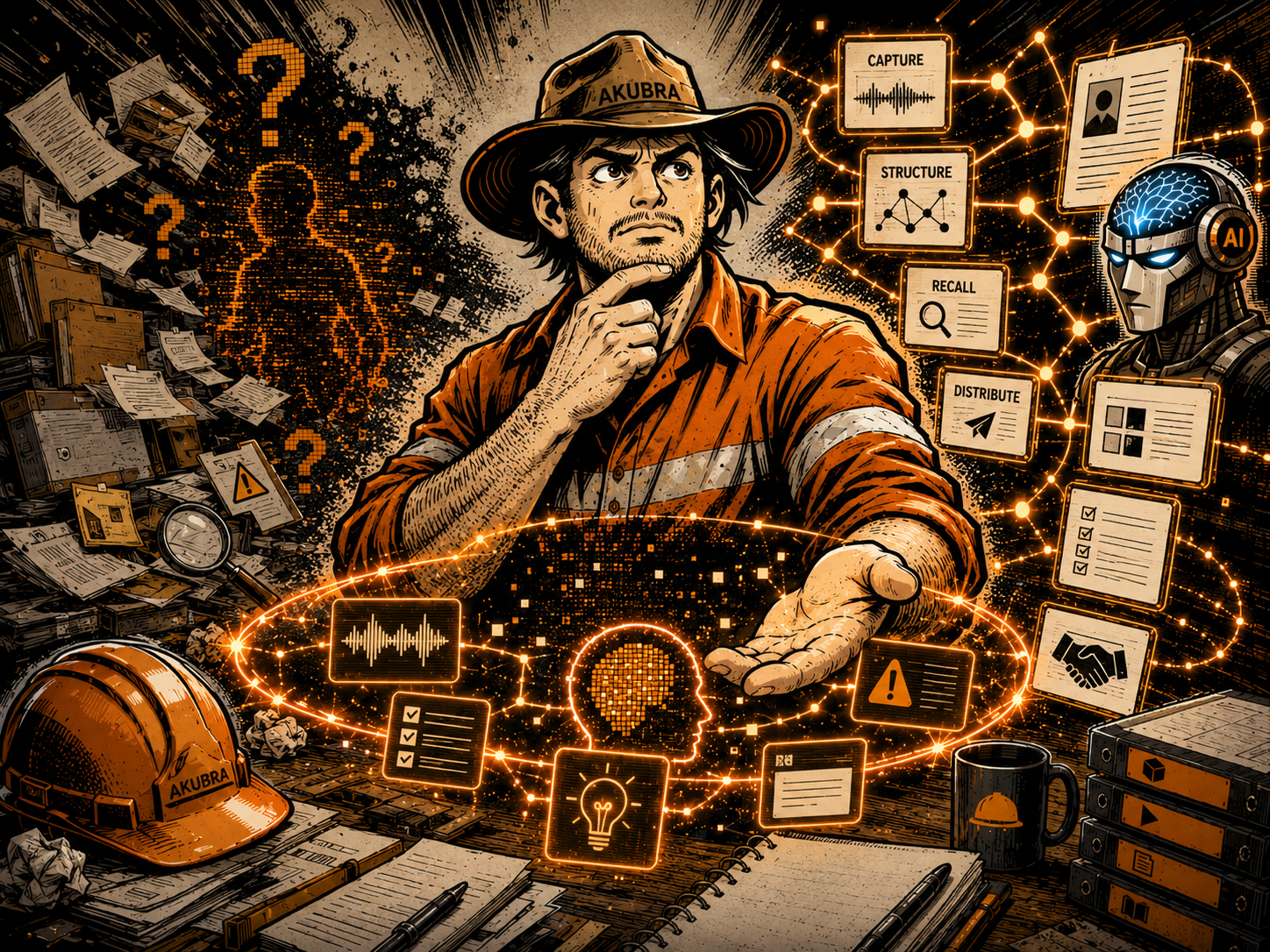
There have been many times over the years where I have needed to do something for part of a job and thought, I know I have done this somewhere before.
Then the search begins.
Was it in that project folder? What was the job number again? Was it saved under the client name? Was it in the old folder structure? Is it archived already? Was it a Word document, a spreadsheet, a OneNote page, an email, a screenshot, or buried nine subfolders deep under some file name that made sense at the time but means very little now?
So, I spend five or ten minutes looking for it, whatever it might be. Sometimes I find it. Sometimes I find something close enough. Sometimes I just give up and end up recreating.
Five or ten minutes does not sound like much in isolation, but over years that becomes many, many hours. Hours spent looking for things I already knew existed. Hours spent trying to reconstruct thinking and work I had already done. Hours spent rebuilding from memory because the system around the knowledge capture was kind of there but not good enough.
That is a strange kind of waste.
It is the waste of knowing, but still not being able to retrieve. It is extremely frustrating when this occurs!
In a small business, it really matters. Every hour spent looking for buried knowledge is an hour not spent on a more productive task for the business.
The Bigger Problem Was Not Just Files
The more I thought about it, the more I realised the file search problem was just one layer.
The bigger problem was actually capture.
Not everything valuable starts as a document.
Some of the most useful thinking starts as a thought, a connection, an observation, or a pattern that appears at an inconvenient time.
A lot of my best ideas do not arrive when I sit down at a desk and schedule time to think. They arrive at random times when an activity intersects with some sort of trigger, a conversation, an observation, the environment.
These thoughts are often random and they do not always arrive as complete ideas. They arrive as connections, patterns.
A client conversation triggers a pattern I have seen before in a completely different industry. A compliance issue starts to look less like a paperwork problem and more like a business architecture problem. A previous project failure connects to a process improvement, future article or product idea.
For a brief moment, the pieces fit together like a puzzle.
That moment matters because that is often where the value is. The value is not just the original thought, observation or experience. It is the pattern recognition, the ability to see that things which look unrelated are actually connected.
The problem is that those moments are fleeting. If I capture the thought, it might survive.
If I do not, it almost always disappears. Sometimes it might come back weeks later when something else triggers it again. Usually it does not, and not in the same form as the original.
That raised an uncomfortable reflection. How many useful ideas have I already lost forever?
Lots, no doubt.
Experience Is Not Enough
For most of my career, I assumed the hard part was accumulating experience.
That is partly true. Experience takes time. It takes exposure to projects, people, failures, investigations, audits, systems, conversations and consequences. In HSEQ, risk management and operational systems, judgement does not appear overnight. It is built through repeated contact with real situations where decisions have to survive contact with reality.
I still believe experience matters enormously. In fact, I think it becomes more valuable as AI improves, because the ability to produce information quickly is not the same as the ability to judge whether that information is useful, adequate, specific or safe to rely on. I’ve already written thoughts on this before you can read them here.
But experience on its own is not enough.
Experience only creates value when it can be applied. To apply it, you first have to access it.
That is where the bottleneck appears.
If experience is trapped in memory, scattered across folders, buried in old files, or lost as unrecorded thoughts, then it cannot reliably become anything else of value. It cannot become an article. It cannot become a framework. It cannot become a template. It cannot become a product. It cannot become client value.
Useful, maybe.
But only if I can find it again.
I Built My Own Framework
This is where the idea of my own framework started to form. I called it “Papillon Echoes”, a nod to Tom Clancy’s: The Division game from years ago.
It started as a practical response to my personal bottleneck.
The early version of the framework is deliberately simple:
Capture before the thought disappears, quickly with minimal friction on life.
Structure before the capture becomes noise.
Store it somewhere stable.
Connect it to related ideas by applying schema and relationship tags.
Recall it when it becomes useful.
Turn it into something that can be distributed.
That might sound like a personal knowledge system, and it partly is. But for me, it is more specific than that.
It is a personal business intelligence system. The goal is to preserve the raw material of future value.
How the Framework Works
The first part of the framework is low-friction capture. This matters way more than it probably sounds. If the capture method is too slow, the idea will not enter the system. I cannot rely on being at a desk, opening the right app, finding the right template, and carefully writing a polished note. That is not how many useful thoughts arrive.
So the current workflow starts with voice.
If an idea appears, I capture it as quickly as possible. It might be a thought, an observation, a lesson learned, an article fragment, a product idea, a client pattern, or simply a connection between two things that suddenly make sense together.
The important thing is that the thought survives long enough to be processed.
I simply say “Hey Siri, Open Voice Memo”, hit the red record button and start speaking.
From there, the transcript gets reviewed and cleaned up if needed. (Apple’s transcripts have been surprisingly good but there are other options in this space like Whisper)
Then it goes into an Echo Capture process that applies structure. This is the important part, because a raw note is useful only to a point.
Each Echo needs enough metadata to make it useful later. What is it about? Is it connected to HSEQ, AI, risk management, consulting, product development, ISO systems, incident investigation, document shop strategy or business development? Is it an article idea, a product concept, a client observation, a framework fragment, a lesson learned, or a recurring pattern, an improvement?
The point is to turn fleeting thoughts into reusable knowledge objects.
The structure does not need to be perfect, but it needs to be consistent enough that the idea can be found, compared, connected and reused later.
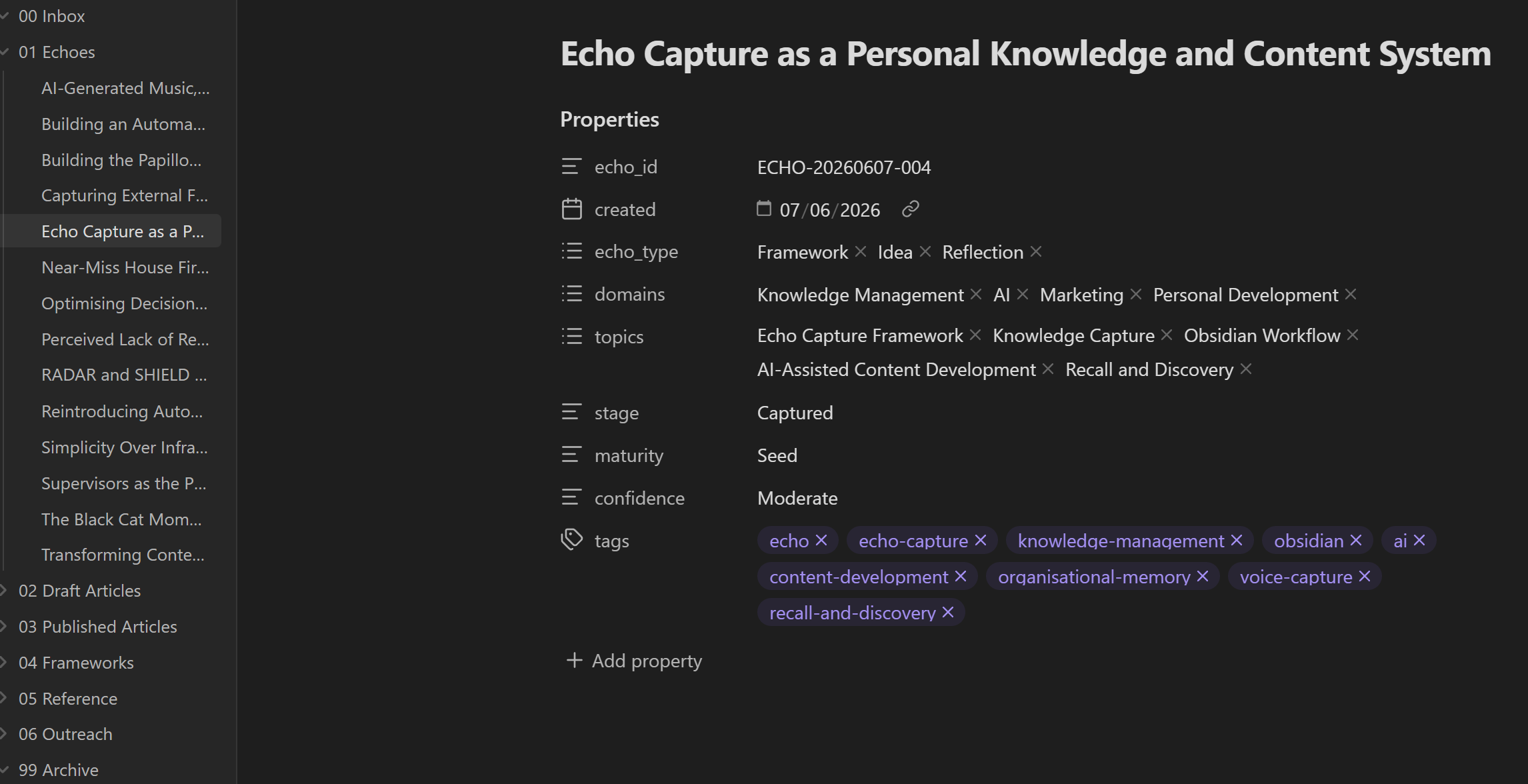
The transcript is run through a dedicated Echo Capture GPT, and outputs structured markdown, YAML metadata. That gives each captured thought a consistent shape. It also means the note can sit inside a broader knowledge system rather than disappearing into another app, folder or random document.
Markdown is stored in a platform called Obsidian, with local markdown files meaning the data (and experience) is always mine.
Once successfully captured, each Echo can follow two broad paths for myself.
The first path is content and asset development. An Echo might become an article seed, a LinkedIn post, a product idea, a consulting framework, a checklist or part of a larger service offer. This very article was born from a captured echo very late one night.
The second path is recall and discovery. This is where the system becomes much more interesting over time. As more Echoes are captured, there is more and more context available.
That means it gets easier to ask better questions later. Have I thought about this before? What have I captured about this topic? What previous project lessons relate to this problem? Have I already written something that could become a template? What themes are recurring across different notes?
The Obsidian search and relationships are already good, but this is where applying AI to a collection of Echoes becomes useful. Not as a generic content generator, but as a retrieval, synthesis and connection layer.
AI cannot retrieve what was never captured. It cannot connect patterns that were never preserved. It cannot help turn experience into assets if the experience disappears before it enters the system.
So the sequence matters.
Capture first. Then structure. Then recall. Then synthesis or discovery via AI. Then distribution.
The Distribution Problem
When I look at Papillon through this lens, the website, articles and document shop make more sense.
They are not just marketing assets or products. They are distribution mechanisms for experience.
An article allows one observation to reach many people. A template allows a framework developed over years to become operational for another business. A document bundle packages a set of ideas into a practical system someone can use without needing a direct conversation with me. Consulting is also a form of distribution, because a client brings a problem and I transfer experience from one context into another.
But distribution can only happen after capture.
That is the part I had not fully appreciated.
It is tempting to think the hard part is publishing more articles, building more products or creating more content. But those are all downstream activities. Before any of that can happen, any underlying idea has to survive long enough to be developed.
This is why Echoes starts with capture.
The goal is not simply to store information. The goal is to preserve the raw material of future value.
A thought captured today might become an article next month. That article might become a framework. The framework might become a template. The template might become a product. The product might solve a client problem. That client problem might generate a new lesson, and that lesson feeds back into the system.
That is the loop.
Capture, structure, recall, develop, distribute, learn, and capture again.
Final Thoughts
I built Papillon Echoes to solve my own bottleneck first.
The framework is simple: capture useful thoughts before they disappear, structure them so they can be found again, and reuse them when they become valuable.
For me, that means better recall, much faster content development, stronger frameworks, and less time rebuilding what I have already worked out before.
I know the same principle applies to many small businesses. If important knowledge is scattered, buried, or sitting in someone’s head, it is fragile.
A capture and retrieval framework will not solve everything, but it can help a business turn experience into something it can actually use, reuse, and build on.
Moving forward, the businesses that learn how to capture and reuse human knowledge will have an advantage over those still relying on memory, folders and luck.
If your business is growing past informal systems, or too much still depends on a few people remembering the right thing at the right time, this is where structured systems development can help.
Papillon helps small businesses design practical capture and retrieval systems for operational knowledge, so important experience is easier to find, apply and improve over time.
Get in touch if you want to explore what that could look like in your business.
